


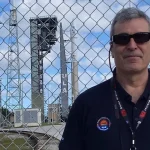

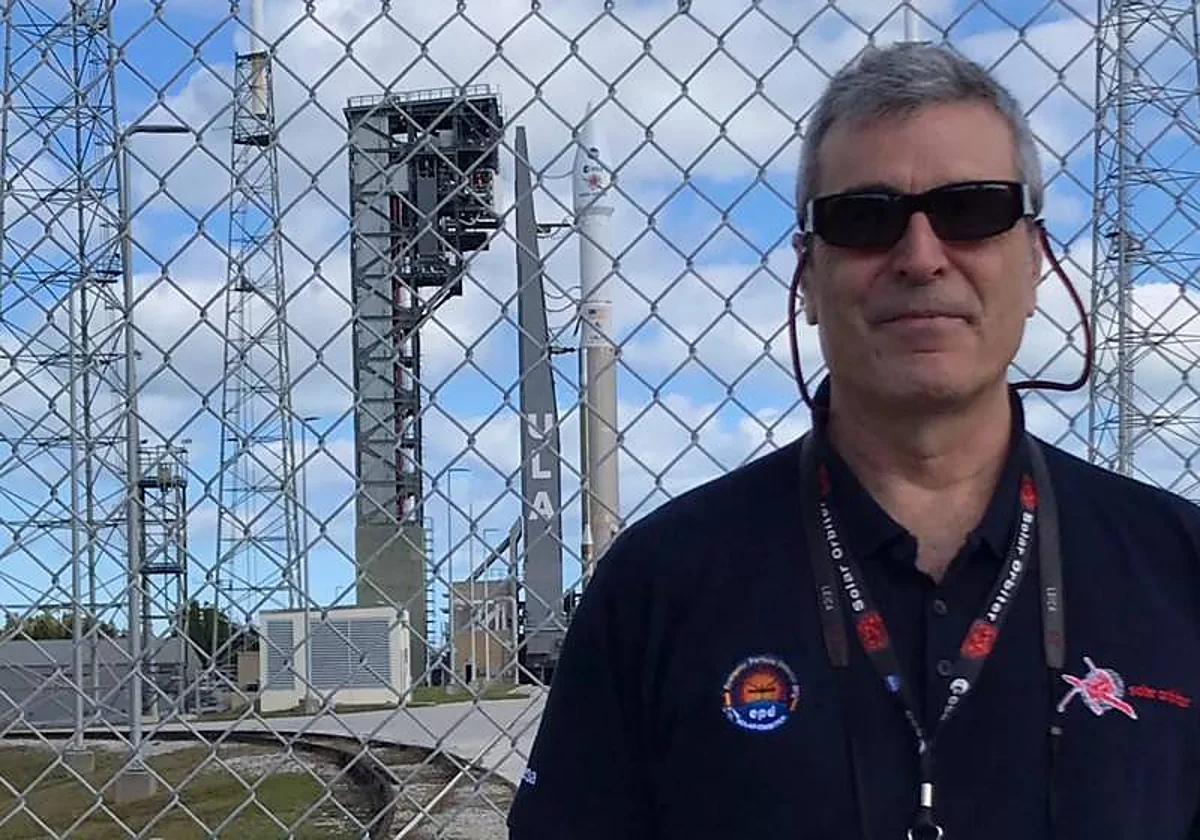
It had been 54 years since a manned space mission had been destined for the moon. The Artemis II rocket has completed part of its work in … lunar orbit and Ciudad Rodrigo has a presence in the teams that make up this project of the American space agency thanks to the Mirobrigense Javier Rodríguez-Pachecoprofessor of Astronomy and Astrophysics at the University of Alcalá, and who collaborates with NASA on this mission.
To explain this relationship between this professor and the space agencies, we must travel to the year 2020: «In that year the European and American agencies counted on us to the launch of a system of cameras and instruments to study the Sun’s radiation“, being the closest to this star, at about 42 million kilometers,” says Javier, “and a while ago NASA contacted us after the first flight on Mars of its ‘Ingenuity’ space helicopter and being affected by solar storms.”
After that first contact, This Mirobigran is part of the team in charge of analyzing the data of the Sun’s emissions and how they can affect this mission in some way.. “Our job is to see the information they receive daily that could endanger astronauts by increasing the radiation dose and to have enough time to find a solution,” he tells LA GACETA. An arduous task since, according to Javier Rodríguez-Pacheco, his job is to convert “binary data, ones and zeros, and deliver them to the space agency in a format where they can work with the information: radioactivity, radiation flow, etc. Likewise, we are at your disposal to process any raw data and resolve any questions you may have.”
Since the start of the mission on April 1, Communication between the university group and the two American teams is fluid. «It is mainly run by two groups: one is ‘M2M’, ‘Moon To Mars’, a NASA office in charge of this area and the other is NOAA, the National Oceanic and Atmospheric Administration, another federal agency that monitors climate, weather, oceans and coasts. “They calculate with our data whether they are within the safety margins.” Although everything may seem far away, the work of this professor andThe data obtained will help clarify the mysteries that still surround the Sunhow these solar storms can affect the Earth and influence satellites, GPS locators, radio communications and electrical networks.
For this Mirobrigense, being part of this adventure is a dream come true. “Since I was little I was very clear that I liked the stars and even more so growing up in Campo Charro, in Ciudad Rodrigo, which allows you to observe them at night and see their wonders and wonder what is up there,” says Javier, who remembers his years at the Los Sitios school “and who was going to tell that child that at 50 tacos I was going to be the principal investigator of a mission of the European Space Agency and NASA. Although Javier lives in Cabanillas del Campo, Guadalajara, and works in Alcalá de Henares, his hometown of Ciudad Rodrigo is always present “and I go whenever I can, my wife is also from there and I have many memories of my years there: from when we inaugurated the new institute near the soccer field, from my friends with whom I keep in touch… I still have a very strong bond with my land, with Miróbriga and for me it is a pride to carry the name of my city in the field of teaching and research.
The Artemis II mission faces its final stretch. The astronauts are expected to land in the Pacific Ocean this coming April 11, in the longest journey in terms of kilometers in space history and which has laid the foundations for man to set foot on the moon again in 2028.