



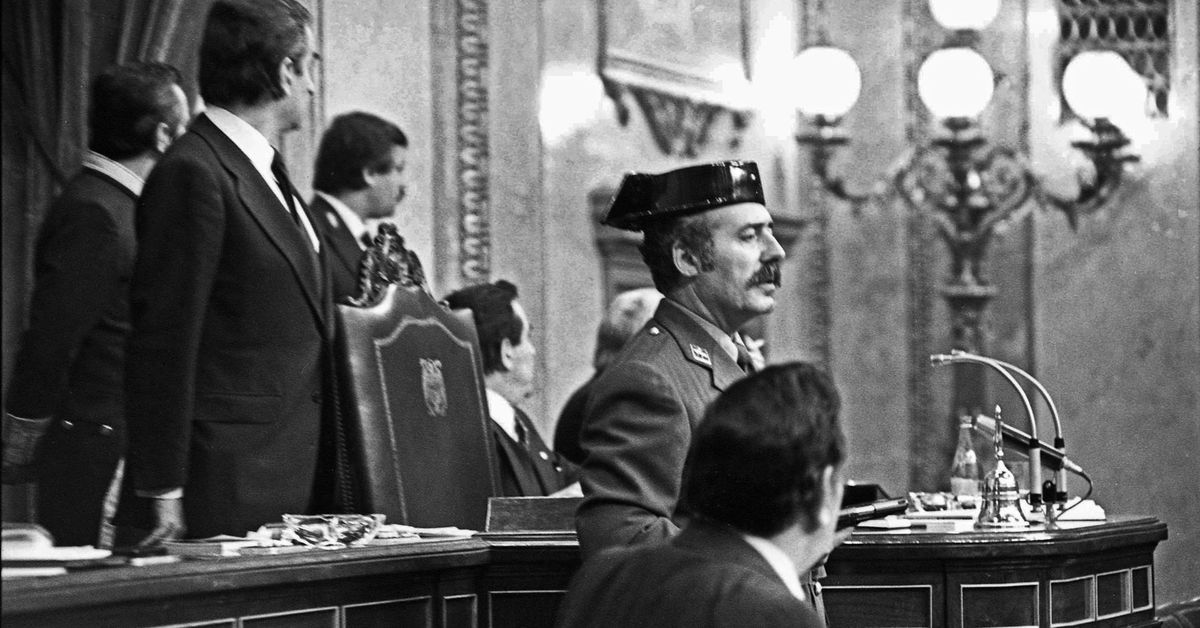
The declassification of the documents related to the 23F coup attempt and their publication this Wednesday has caused great expectation to know all the documentation that until now had been secret. Among the 153 documents, which have been published on the La Moncloa website and can now be consulted, there are documents from the Ministry of the Interior, Defense, Foreign Affairs, the Civil Guard with various transcripts of different telephone conversations and from the National Police.
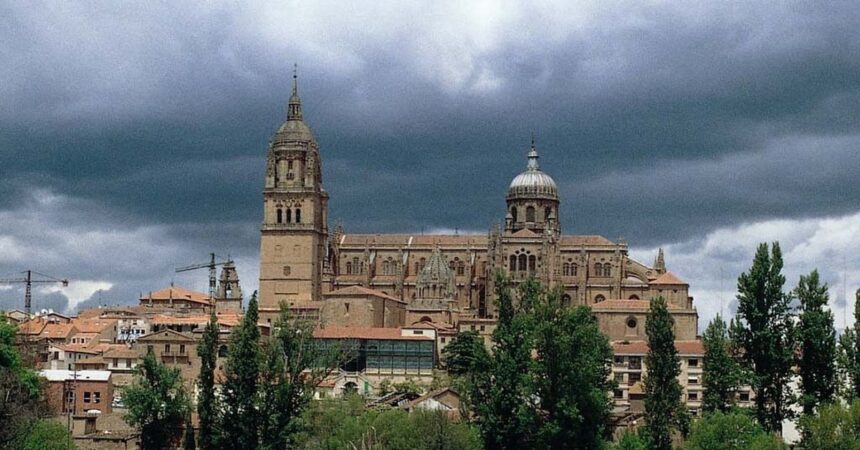
It is in the latter, in the documents provided by the General Directorate of the Police, where Salamanca appears. Specifically, in two reports from the General Information Commissioner’s Office that collect reports from the different senior police headquarters on the situation in the different regions and the protest actions planned after the occupation of the Congress of Deputies. These are reports dated February 25 and 26 that compile a compilation of the situation in the different provinces.
Salamanca in the papers of 23F February 25, 81
In the case of Salamanca, it is the Valladolid Police Headquarters who refers the situation in Salamanca. Thus, on the 25th they report that there is “general normality in the police region” although in Salamanca a student assembly has been called for that same February 25th at the Faculty of Philosophy and Letters in which the objective was to address the situation after the failed coup d’état. The National Police reports that 300 students participated in it and that it was finally held at the Faculty of Medicine.
The report also includes a distribution of propaganda on the same day to incite a popular rally by the Revolutionary Communist League. The protest was scheduled for 8 p.m. that same day in the Plaza Mayor. In the propaganda “the purification of the Armed Forces is demanded,” the document states.
Salamanca in the 23F papers
On the other hand, in the report of February 26, the Higher Police Headquarters of Valladolid reports that in the province of Salamanca the parliamentary parties and the union centers are calling for a “popular demonstration under the motto For freedom, for democracy and for the Constitution” on the 27th.
It is worth remembering that a year after 23-F, in August 1982, a late-Franco weekly newspaper, Actual, began to publish blacklists in which the more than 3,000 people who were scheduled to be murdered the day after the coup d’état appeared, as reported in 2019. this report from Salamanca 24 Horas. The list included seven people from Salamanca The list of people from Salamanca named by the far-rightists who published Current It was short. It was only made up of seven people: the politicians Juan José Melero and Jesús Málaga, Lucía García Hernández, number 1 on the PCE list in Salamanca for Congress in the 1977 general elections; Inocencio García Velasco, professor of International Law at USAL and number 2 on the PCE list for Congress in 1977 and number 1 for the Senate in 1979; Miguel Miñana Alonso from Bejar, number 3 on the PSOE list in Salamanca for Congress in the 1977 elections; Gonzalo Rivera Cebrián, number 3 of the PCE to Congress in 1977 and Fernando Galán, professor of Biology at the University of Salamanca who received the city’s Gold Medal in 1985.
The documents declassified after the Government agreement was published this Wednesday in the BOE correspond to 153 documentary units. This is “all the documentation that has been found so far,” according to government spokesperson Elma Saiz. The published agreement states that it is about “declassifying any matters, acts, documents, information, data and objects related to the attempted coup d’état” of 23-F. And it is done at the proposal of the ministers of: Foreign Affairs, European Union and Cooperation; of the Presidency, Justice and Relations with the Courts; of the Minister of Defense, and the Minister of the Interior. In the three-page text, it is alleged that the years passed since the attempted coup d’état – whose authors were definitively convicted of a crime of military rebellion by the Supreme Court in the ruling of April 22, 1983 – allow the information referring to these events to be declassified “without generating any real and present risk.”