





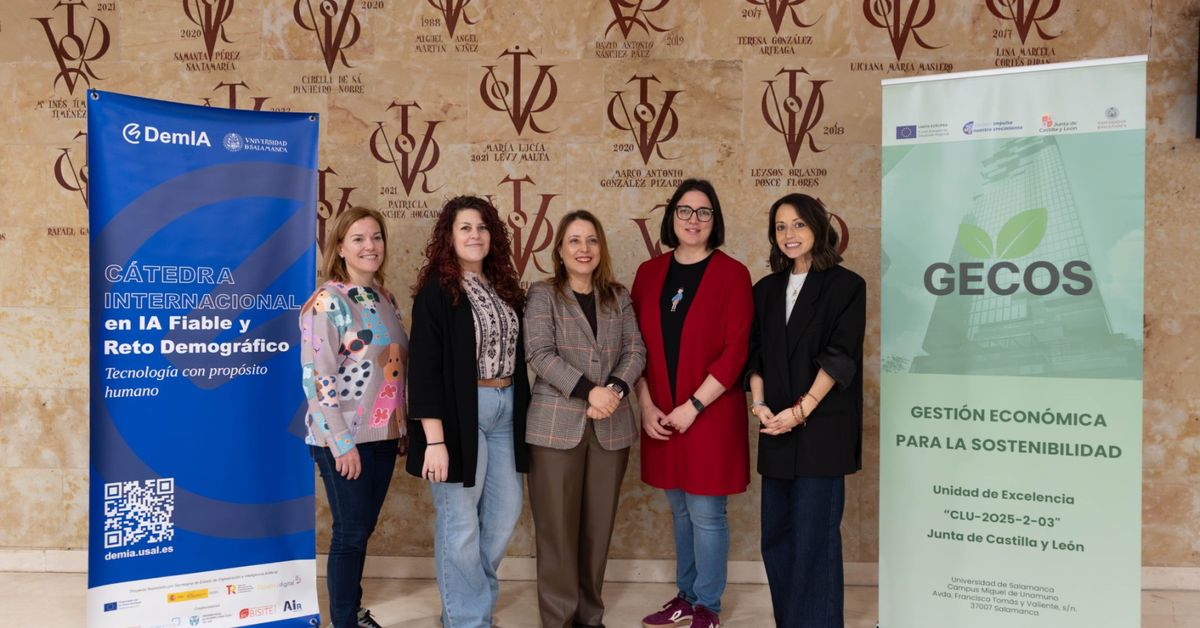
The Unit of Excellence in Economic Management for Sustainability (GECOS), linked to the University of Salamanca, and the International Chair in Reliable Artificial Intelligence and Demographic Challenge (DemIA), belonging to the BISITE Research Group of the USAL, have signed a collaboration agreement with the aim of establishing a solid framework for the development of joint activities in research, training and knowledge transfer.
The agreement will allow researchers and teachers from GECOS and DemIA to actively participate in joint research projects, promoting the publication of co-authored academic works based on applied research. The organization and participation in seminars, symposiums, conferences, workshops and other academic events that allow sharing results, experiences and knowledge with the scientific and professional community will also be promoted.
Cooperation also includes the constant exchange of scientific, technical and academic information, as well as the dissemination of research activity through knowledge transfer initiatives, reinforcing the impact of projects both locally and internationally.
Initially, the agreement will be valid for three years, with the possibility of automatic extension for equal periods, which guarantees the continuity and stability of the collaboration in the coming years. In this way, the University of Salamanca continues to consolidate its position as a benchmark in multidisciplinary research, promoting the integration of knowledge between different academic units and strengthening the advanced training of its researchers.
Real goals
GECOS aims to offer real solutions to the challenges of today’s business world through a multidisciplinary approach. Its work focuses on sustainability from a comprehensive perspective: environmental, social and economic, which allows it to identify structures and processes that promote more resilient and competitive corporate management.
For its part, DemIA offers a response to the challenges posed by the demographic challenge in society, with special attention to territorial cohesion, environmental sustainability and human habitability. It relies on the opportunities provided by artificial intelligence to develop innovative solutions, applicable to different social, economic and environmental contexts.