


In recent years, coinciding with the hot season, many Spanish municipalities have had to face large forest fires that have devastated thousands of hectares of mountains and vegetation. Flames that have devoured infrastructure, homes, machinery, affected livestock, and that not even the fire extinguishing services could stop with their thousands of resources. Situations that have been debated for some time, with an obvious conclusion: fires must be stopped before they start.
Without going any further, last summer, the province of Salamanca lived one of the most tragic episodes on the same day, August 15, where part of the province suffered several fires at the same time, El Payo, Cipérez and La Sagrada, that continued until well into the early morning in Danger level 2. In the three cases, especially in El Payo and Cipérez, the most virulent, significant material damage was caused, with large areas of grass burned, and where in the case of the Cipérez fire, warehouses, barns and even homes with neighbors who had to be evacuated were affected.
Days before another forest fire broke out in The Poolat the gates of the town, and in Martin de Yeltesalso at Level 2. And, all of them were declared ‘seriously affected area’ by the Government of Spain and at the request of the Junta de Castilla y León. Already in 2022, Salamanca experienced a similar situation with the virulent fires that affected the Maíllo, Monsagro and Candelario after entering through Las Hurdes.
Some situations that highlight the importance of extensive livestock activitywhere grazing plays “a fundamental role in fire prevention.” The Ministry of the Environment highlights that extensive livestock activity is “a traditional economic resource, a strategic activity for the Junta de Castilla y León, determining in the management of the territory, in environmental sustainability, local economic activity and rural development in the autonomous community, key in the prevention and control of forest fires.”
Likewise, the Board highlights that grazing is an activity carried out for centuries in the mountains, an action that has shaped the agrosilvopastoral landscape, giving rise to “landscapes of high ecological value and great biodiversity.”
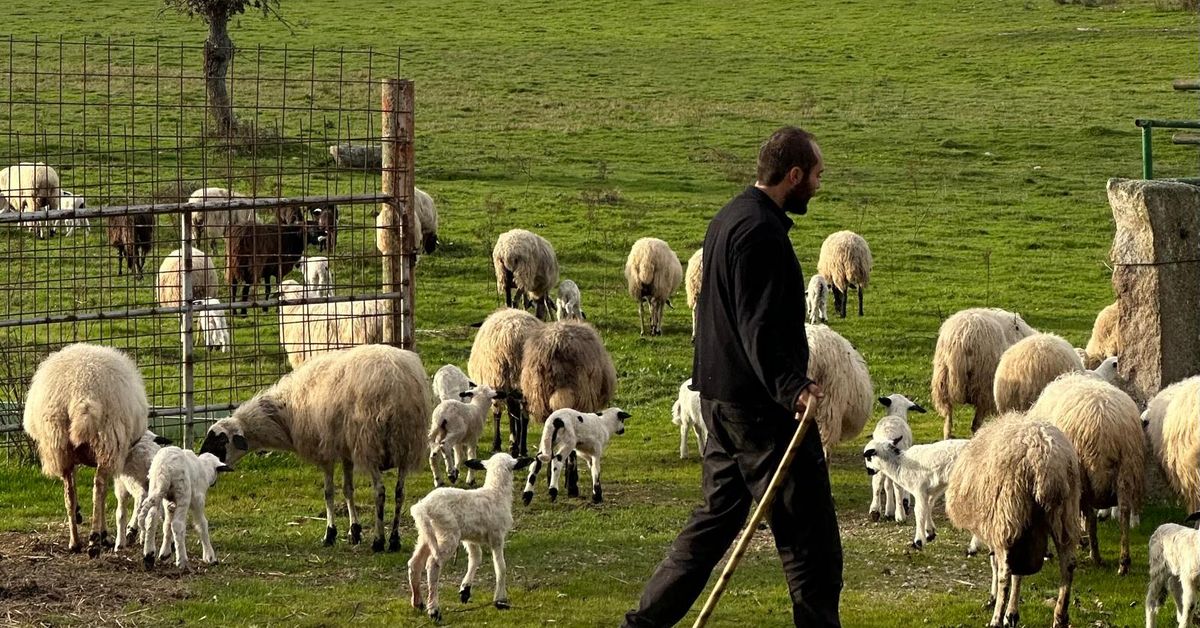
Juan Antonio Sánchez Cuadradoa shepherd of Pereña de la Riberawhich currently has about 270 sheep, warns that “there are areas that are abandoned, with uncontrolled vegetation and if there is a big fire the towns of Salamanca are miraculously saved, as has already been seen this summer.”
Juan Antonio Sánchez Cuadrado, rancher and shepherd in Pereña de la Ribera
This young rancher says that he has the sheep in plots and assures that it is not usual to take them out through the town to graze, although he acknowledges that “it would be important because there are fewer and fewer people who want to dedicate themselves to grazing and because where there are livestock the ground is clean. When spring comes, everything begins to sprout again and it quickly gets out of control if there is not good maintenance, which is what the animals do.”
Grazing plays a fundamental role in fire prevention because it breaks the horizontal continuity of fuel in the lower layer and also prevents it from passing from the ground to the crowns.
In this regard, from the Environment they point out that grazing “plays a fundamental role in the prevention of fires because it breaks the horizontal continuity of the fuel in the lower stratum and also prevents it from passing from the ground to the crowns. In addition, the reduction of fuel carried out by livestock allows the intensity and speed of the fire to be reduced, which favors its control and the recovery of the ecosystem once the fire is extinguished.”
In the past, in fact, there were fewer fires because the mountains were cleaner thanks to the presence of goats and sheep in these places. “A brushcutter machine does the job faster, but the use of sheep and goats is good for maintenance. For example, the goats crush the brambles more, but their job is to first clean the mountain with the machines and then bring the cattle in so that they can take advantage of it and keep it clean,” emphasizes Juan Antonio.
The good thing would be that when a land burns, then they let the cattle, cows or sheep in, so that they crush the land more
Asked about the comparison of a pasture/mountain where there is a herd and where there is not, the shepherd says that “where there are cattle it is immediately different because the ground is clean. On the other hand, in those areas that are without cattle everything is abandoned in a bad way. Here in Pereña there is a plant called barceas that burns a lot and can immediately cause the fire to get out of control. What’s more, recently a resident of the town who was burning caught fire where there are some barceas and “They burned right away and it’s winter, but it burns a lot and they catch fire right away. That’s why the good thing would be if when a piece of land burns, then they let the cattle, cows or sheep in, so that they can crush the land more.” A task that emphasizes “it is good to do it every year.”
Currently, there are many municipalities in Spain already aware of the work of the preventive grazingan activity carried out mainly in the Community of Madrid to clean the mountain area and those more wooded with the intention of reducing fires with the rise in temperatures. In Salamanca There was a time when the Aldeadávila de la Ribera City Council team carried out this prevention work in the area of Las Arribes; an activity that has also been carried out in other points such as the Ciudad Rodrigo region. And although there have been several towns that have wanted to carry out this project, for one reason or another it has not been made effective and is only carried out punctually, on their own and without financial remuneration in some parts of the province with the presence of sheep and/or goats.
Sheep of the Pereña shepherd Juan Antonio Sánchez Cuadrado
Since 1995, the Junta de Castilla y León has developed a aid line for carrying out silvopastoral actions within the Rural Development Program of Castilla y León, currently managed by the Ministry of the Environment, Housing and Territorial Planning, whose objective is the “reduction of fire danger through clearing and subsequent use of the rebound by livestock. A change in the structure of the vegetation, making it less dangerous in the face of fires.” A plan that consists mainly of clearing brush and installing livestock infrastructure.
Environment data show that in the period between 2007-2013, the municipalities that hosted these actions saw a “notable decrease in the number of fires, especially in Burgos, León and Zamora” and that “at the regional level The number of fires was reduced by 46% in municipalities with aidwhile in those without actions, fires have increased by 27%.”
At the end of 2025, the Junta de Castilla y León from the Agriculture area called aids intended for the ‘non-productive investments in agricultural holdings linked to mitigation-adaptation to climate change, efficient use of natural resources and biodiversity’ to “support extensive livestock farms through non-productive investments that improve the use of natural resources and prevention of climatic adversities; and to enhance investments related to biodiversity in extensive livestock farms and improvements in pastures.” Facing this In 2026 there will be a new call for these aids, although the date is still unknown.
In Castilla y León there are more than 3,500 Public Utility Forests that occupy an area of 1.8 million hectares, out of a total of 5 million forest hectares. To prevent trees and bushes from penalizing the rancher and preventing him from receiving a subsidy for this, “in 2023 the PAC reviewed this coefficient and at this time the Junta de Castilla y León is working to solve this situation that involves wasting one of the main assets for the prevention, control and extinction of fire.”
If preventive grazing were extended and, therefore, made effective in more municipalities, it could be a motivation and an opportunity for young people to choose to build a life in rural areasperforming these jobs, often forgotten, but essential for the care of nature and the prevention of large forest fires. “Their thing is that they paid more and helped us young people, especially, because here in the town, as everywhere else, there are people who rent you the land or give it to you directly so that the cattle can use it, but there are also others who prefer that the land be lost and that’s where the problems come when there is a fire because the grass is a fuel. Without help it is difficult for a young person to come to the town to take up a trade like this,” concludes Juan Antonio.