





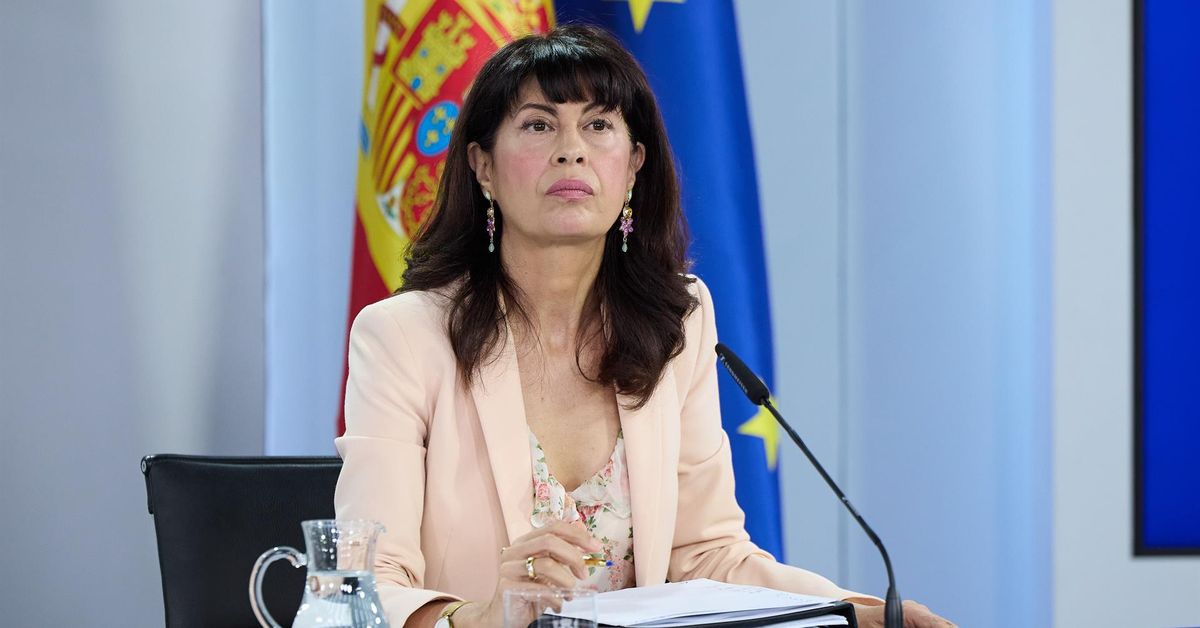
The Ministry of Equality aims for the VioGén system, the comprehensive monitoring platform for cases of gender violence, to be implemented by the end of the year in all municipalities with more than 5,000 inhabitants that have local police in Castilla y León. Currently, there are 71 municipalities of this size in the Community, of which 62 are already incorporated into VioGén, so only 9 are missing. These are Valle de Mena (Burgos), Bembibre, Cacabelos, Fabero, La Robla, Valverde and Villafranca (León) and Íscar and Pedrajas (Valladolid).
The Minister of Equality, Ana Redondo, took advantage of a meeting with the head of the Coordination Unit against violence against women in Castilla y León and the Government delegate, Nicanor Sen, to ensure that it is a “possible” and “ambitious” objective, after having incorporated VioGén into 88 percent of the towns with more than 5,000 inhabitants in the Community. The system, which was put into operation in July 2007, had only four agreements of this type from municipalities in Castilla y León and, now, 62 have already been added, which, in Redondo’s opinion, demonstrates the effort made between the town councils and the ministries of the Interior and Equality and the work carried out between the police. “It is a system that saves lives every day, by alerting the State Security Forces and Bodies of dangerous situations that victims of gender violence may be suffering,” he stated.
After recalling that the Community claimed one fatality last year, the minister made it clear, as reported by the Ical Agency, that one woman is “a lot”, which is why she advocated putting in place all the available instruments and the necessary coordination to prevent sexist violence from claiming more lives in Castilla y León and Spain. That is why, before signing the agreements, he stated that city councils will have to be “incentivized”, thanks to the funds provided for in the State Pact against violence against women, in addition to training among municipal police officers.
The system allows the different public institutions that have powers in matters of gender violence to come together; integrate all the information of interest; carry out a risk estimate; monitor and protect victims, depending on their level, and carry out preventive work, by issuing warnings, alerts and alarms, through the Automated Notifications Subsystem, when any incident or event is detected that may endanger the integrity of the victim. Therefore, a network is established that allows for the rapid, comprehensive and effective monitoring and protection of abused women and their children.
The meeting also served for Ana Redondo to address the 24-hour crisis centers of comprehensive care for women victims of sexual violence, which in Castilla y León are called Atiendo points, noting that work is being done to recognize a basic portfolio of services at the national level. After benefiting from European Next Generation funds, 60 24-hour crisis centers have been created in Spain, of which nine are in the Community, one in each provincial capital. “It has required an enormous effort to ensure that there were no first- and second-class citizens and victims throughout the national territory.
Ana Redondo pointed out that these types of points offer legal, psychological and job placement services, which the Ministry wants to be common to the whole. “We are going to continue working with the Government delegations and the coordination units against violence against women as well as in the next Sectoral Conference to advance in this direction when it comes to caring for victims of gender violence and sexual violence,” he added.
New contract anti-abuse bracelets
Asked about the tender for anti-abuse bracelets, the Minister of Equality declared that as of May a new contract will begin to operate, with more reliable anklets that will incorporate “all” the advances and improvements detected. Something that will translate into the cost of the service, which will go from 52 to 71 million euros, with the possibility of increasing it to 111 million with two-year extensions, up to a total of five years.
Vicarious violence law
Regarding the future vicarious violence law, Redondo recalled that it is something that is included in the State Pact and that has been worked on for more than a year. For now, he was “optimistic” with the political will for it to reach Parliament, where it will be able to incorporate other “visions” and “sensitivities, via amendments. “It represents a maximum effort to reconcile the different interests and provide answers to citizens,” he specified. In this sense, he noted that the Ministry is in contact with the associations to address the needs detected.
After commenting that it will be a “new” law and a reference worldwide, since nothing similar exists, he made it clear that the aim is to avoid a ‘Bretón case’ and thus prevent re-victimization and do more harm to women, even if it is from prison.
Finally, he referred to the abolitionist law on prostitution, which is also included in the State Pact, in addition to being a “commitment” of the Socialist Party to “abolitionism.” He advanced that work is being done on a text, which is “fairly advanced,” which will have to go through a “series of filters” and have technical contributions, both from the Academy and feminist activism.
In connection with this law, the Government of Spain has requested a macro survey from the CIS (Center for Sociological Research) to find out the opinion of citizens about prostitution. In principle, the results of this survey will be known next month to find out what men and women, of different ages and social backgrounds, think in relation to this issue. “It will give us an image that can then be transferred to that bill to respond to a citizen need,” he said.