





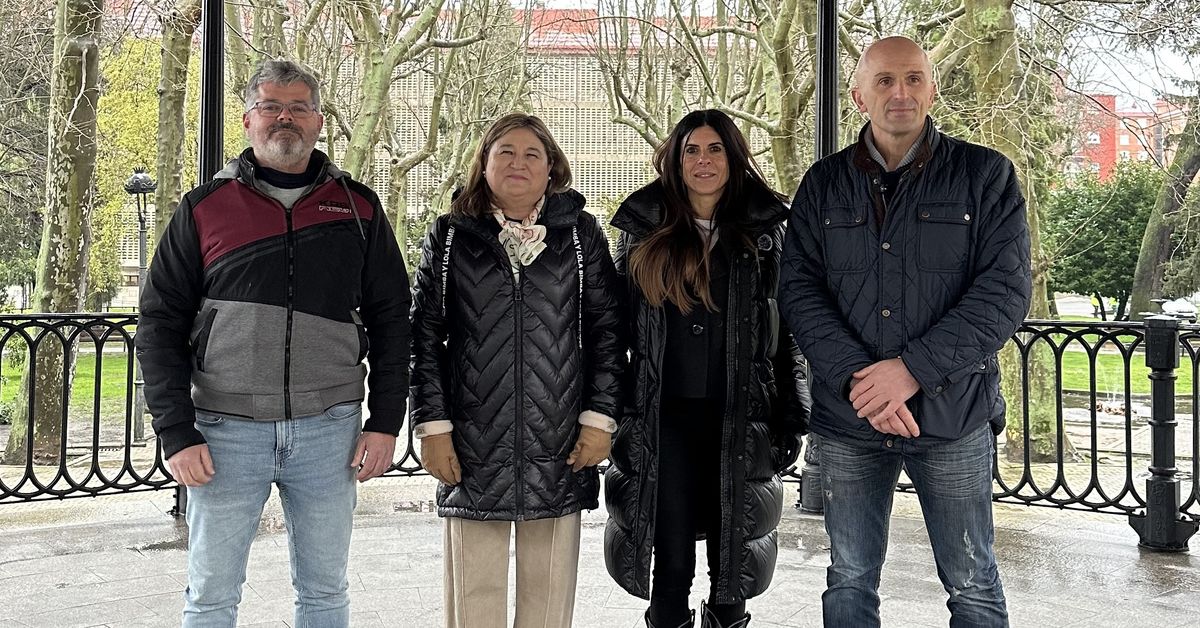
Chabela de la Torre, number one on the list of candidates for Salamanca of Nueve Castilla y León, visited Béjar this Friday accompanied by Eusebio Sánchez, Manuel Hernández and other members of the formation. De la Torre has denounced the abandonment to which, for decades, Béjar and its region have been subjected by all political parties and all institutions. In this sense, he has stressed that, although “the main obstacle to the progress of Béjar is, without a doubt, the chronic political instability of its City Council”, this situation “does not exempt the Junta de Castilla y León from responsibility.” “It is not enough to come to Béjar, sign checks and leave. That money belongs to all Castilians and Leonese, and the Board has the duty to guarantee its best use,” he stressed. With this diagnosis, Nueve Castilla y León assumes a clear commitment to the region: to address once and for all the structural problems that Béjar is experiencing and to activate an ambitious, measurable and sustained revitalization program over time.
Among the proposals announced, the spokesperson highlighted three priority axes: Investment in a large-scale data center. The proposal is based on real assets of the municipality: strategic location, availability of land and infrastructure of old textile factories, abundance of water and energy, and human capital with experience and training. Reinforcement of resources and personnel so that the regional hospital operates at full capacity. The objective is to reduce waiting lists, avoid unnecessary trips to Salamanca and generate qualified local employment. Transformation of Llano Alto into a High Performance Sports Center, integrated with the training offer of the University of Salamanca and the Integrated Vocational Training Center. The measure would allow more than a hundred high-level athletes to be attracted to Béjar throughout the year, with a direct economic and social return for the entire region.
For his part, Eusebio Sánchez from Bejar has pointed out that, for Béjar to be able to reindustrialize, it is essential that Red Eléctrica Española (REE) undertakes an investment that guarantees a stable and sufficient electricity supply for the textile city. He has warned that, currently, the supply depends on a 132 kV line, built in the sixties and managed by Iberdrola, which is “clearly saturated.”
In this context, it has concluded that ensuring energy for a future industrial Béjar requires the urgent construction of a 220 kV line to replace the current infrastructure. As an example of the real impact of these limitations, Sánchez has cited the situation of the Béjar Industrial Estate, where the plots of the agri-food sector have a minimum and insufficient power reserve of 65 kV. “This slows down the arrival of new companies and, for those that try, million-dollar investments are required to reinforce the line and the polygon’s transformation centers,” he added.
In relation to La Covatilla, Sánchez has reviewed the needs and pending investments and has highlighted Nueve Castilla y León’s commitment to a public-private management model as a key piece to guarantee its viability. Furthermore, he stressed that, despite being the main tourist-sports infrastructure in the province of Salamanca, municipal management “has turned it into one of the biggest problems for the city.”
At this point, he recalled the existence of a ruling that obliges the City Council to pay 4.2 million euros to Unicaja, derived from the municipal award of the 17 lots of the GECOBESA bankruptcy liquidation. The resolution was appealed by the City Council in May 2025 before the Superior Court of Justice of Castilla y León and, if confirmed, it would have a direct impact on the municipal coffers of 4.2 million, plus interest – as indicated – “at a rate of 13,000 euros per month”, which could raise the total cost above 7 million euros.