

There are times when an operating room becomes more than just a place where medicine is practiced. Sometimes it becomes a border between two different lives: the one before and the one after. Before opening your eyes and after seeing again.
That is what happened for five days in a hospital in Gambia, where a group of health professionals linked to Salamanca spent days of more than ten hours operating without rest. When they returned to Spain they had in their memory 120 cataract surgeries, several glaucoma operations and dozens of stories that are difficult to forget.
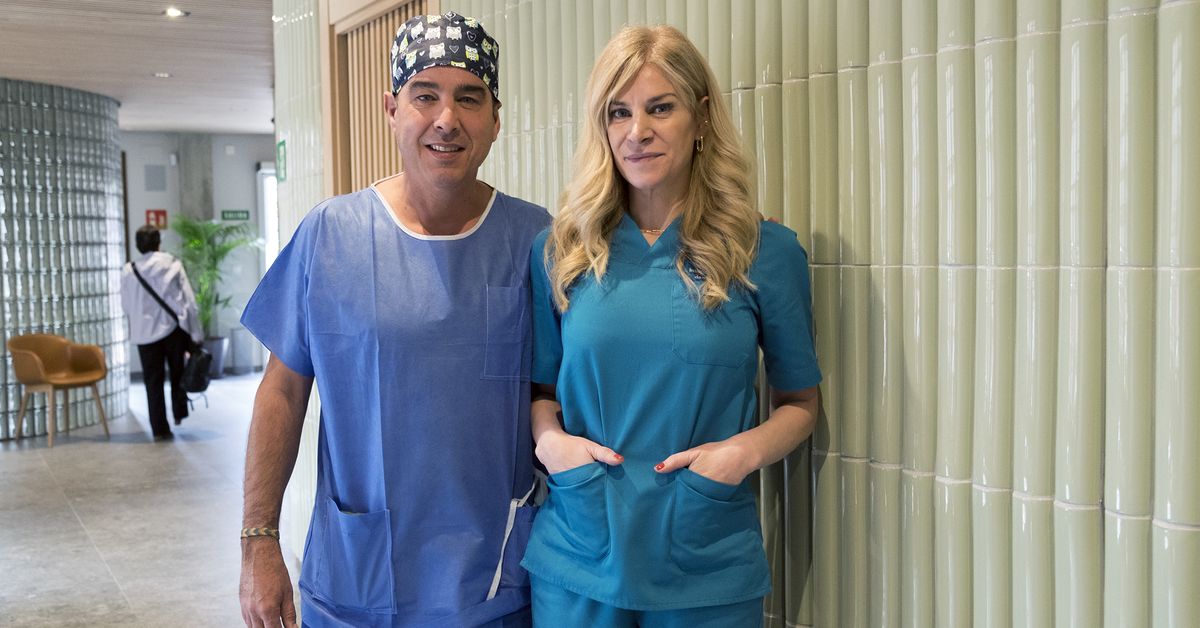
Behind the expedition is the Salamanca ophthalmologist Ernesto Alonso Juárez, medical director of the Salamanca Institute of Ophthalmology (Insadof), who decided to return to Africa more than two decades after his first experience on the continent. He did so accompanied by a health team made up of doctors, nurses and instrumentalists, and also by his own daughter, a Family Medicine resident.
For five straight days the team worked practically without rest. They got up early, went to the hospital and began a chain of interventions that only stopped briefly to eat. When they finished, at night, they returned to the small hotel where they were staying to discuss the day, share impressions and prepare for the next day.
But to understand why someone decides to cross half the world to operate for free on strangers, you have to go back 25 years.
A first time impossible to forget
The first time Ernesto Alonso set foot in Africa he was barely thirty years old. The year was 2001 and I was then working in a clinic in Santander that collaborated with medical projects in Togo. There he had the opportunity to participate in a surgical expedition in the city of Dapaong, near the border with Burkina Faso.
What he found when he arrived was a very different scenario from what he knew. The hospital where they were going to work barely had any equipment. On the first day, before they could operate, they literally had to carry a wheelbarrow full of dirt out of the operating room. The scene he saw when he entered stayed with him forever. In a nearby room, two local doctors were performing a cesarean section on a patient lying on a makeshift board. That vision was his first real contact with medicine in a context where resources were minimal and each intervention was carried out with what was at hand.
Even so, the expedition managed to carry out nearly 200 cataract operations in just ten days. Patients arrived on foot from villages located dozens of kilometers away. “They came with a cane, guided by a family member,” he remembers. “They slept outside the hospital waiting for their turn.” Many of those patients were barely fifty years old. At that time, explains the ophthalmologist, life expectancy in the area was very low and vision problems appeared much earlier than in Europe.
The following year they returned to the same place. This time they did it with a more ambitious project: transporting maritime containers and converting them into a fully equipped portable operating room that ended up being fully operational there.
Then life continued its course. New professional projects arrived, the opening of his clinic in Salamanca, family, children and daily responsibilities. Africa remained in memory until this year.
A return 25 years later
The idea of returning had been on his mind for some time. But the final push came in an unexpected way: her eldest daughter. She had just finished medical school and was starting her residency. When the possibility arose to participate in a new expedition organized by the Association Against Blindness International (ACCI), Ernesto decided that the time had come.
The project would be developed in Gambia and would bring together health professionals from different parts of Spain. Eight people traveled from Salamanca: two ophthalmologists, two instrumentalists, a nurse, an anesthetist and two doctors. In total, the team that worked there during those weeks was more than fifteen professionals.
The objective was clear: operate on as many cataracts as possible, one of the main causes of blindness in many African countries. However, the reality they encountered was not simple. Organizing a medical expedition of this type involves overcoming a bureaucratic labyrinth. Teams must send surgical material in advance, obtain health permits, manage visas and overcome administrative controls. In some cases, they even have to negotiate with local authorities or pay unexpected fees to be able to transport medical equipment.
The group was about to cancel the trip just one day before starting operations. The hospital where they were initially going to work was no longer available and they had to move the entire expedition to another state health center, although they finally managed to settle in and start operating.
Ten hours a day in the operating room
Once inside the hospital, the pace of work was constant. The team started early and spent the day chaining operations. In Spain, cataract surgery is usually scheduled in advance, in a perfectly prepared environment and with all the necessary equipment. In Gambia, on the other hand, every day was a race against the clock. The goal was to operate on as many patients as possible. During five days they performed 120 cataract surgeries, in addition to other eye operations. “If you work at a fast pace you can operate on more people,” explains the doctor. “You know that every operation means that someone is going to see again.”
The days lasted until seven or eight in the afternoon. Then they returned to the hotel where they were staying, a small establishment that, as they say with a laugh, was “very good for what Africa is and a little fair for what Spain is.” There came the time to rest, have a beer, talk about the day’s operations and the feeling of having done something useful.
Decide who to operate
One of the most intense places of the expedition was not the operating room, but the triage area. There patients were evaluated to decide who could really benefit from an operation. Ernesto’s daughter and also his sister, a cardiologist, worked at that point, who joined the team to collaborate in whatever was needed. His job was to examine dozens of patients every day. It was necessary to check whether they really had cataracts or whether the vision loss was caused by another eye problem that could not be resolved with surgery.
In contexts with limited resources, every decision counts. “If you operate on someone who has a damaged retina, for example, the operation will be of no use,” he explains. “You are using material and time that could help another patient.”
The pressure was constant, and sometimes there were attempts to sneak in patients ahead of others: family members, acquaintances or people with some kind of relationship with the local staff. Sorting all of this required patience, medical judgment and an enormous capacity for work.
Stories that are not forgotten
On an expedition of this type, every day leaves images that are difficult to erase. The ophthalmologist still remembers cases from 25 years ago: children with serious injuries to their faces, babies with congenital cataracts or elderly people who regained their sight after years of living in the dark. This year there were also particularly intense moments. One of them occurred when the team had already completed all scheduled operations. The cataract surgical supplies had run out and they were preparing to return, then a young woman arrived. He was in his early twenties and suffered from very advanced glaucoma, a disease that damages the optic nerve and can cause irreversible blindness. In one of his eyes he had already completely lost vision while in the other he barely retained a small trace of vision.
The team decided to intervene, although it was not part of the initial plan. The operation could not restore her lost vision, but it could stop the progression of the disease and prevent her from becoming completely blind. “It was like the icing on the cake of the trip,” recalls the doctor.
A clash with reality
Trips like this also change the way you look at your own country. When the team returned to Spain, the predominant feeling was a mixture of relief and reflection. “You realize how lucky we are,” he acknowledges.
It’s not just about the healthcare system or medical resources. Also something more basic: the simple fact of being born in a place where opportunities are different. “You can complain about many things,” he explains, “but when you come back from a place like this you understand how lucky we are.” At the same time, experience shows that happiness does not necessarily depend on having more. In many of the places they visited they found people who, despite having very little, maintained a surprisingly optimistic attitude to life. “You see that you can be happy with very little,” he reflects.
A shared experience
For Ernesto Alonso, one of the most special aspects of the trip was sharing it with his daughter. Working together in such a demanding context further strengthened their relationship and allowed the young doctor to live an experience that will probably mark her way of understanding the profession. “They are experiences that create a lot of unity,” he explains.
For her it was also a way to discover another side of medicine: that which is practiced far from modern hospitals and where the objective is not so much technical perfection as helping the greatest number of people possible.
The next trip is already underway
The experience has left a deep mark on the entire team, so much so that they are already preparing the next expedition. If everything goes as planned, they will return to The Gambia in January 2027. The organization is already working on the financing, logistics and permits necessary to repeat the project.
The response from health professionals interested in participating has been enormous. “There are many people who want to go,” explains Ernesto. Some even offer to pay their own expenses in order to be part of the expedition. Because, as those who live such an experience discover, helping also transforms those who help.
A drop in the ocean
When asked if these expeditions really change anything, the ophthalmologist responds with a mix of humility and sincerity. “It’s a drop in the bucket,” he admits.
The need in many African countries is enormous and no group of doctors can completely solve it, but each operation changes the life of a specific person. Every patient he sees again can work, walk safely, recognize his family or read and that is enough to justify the effort. “Since you know how to do something,” he concludes, “what less than trying to make it useful for someone.”