






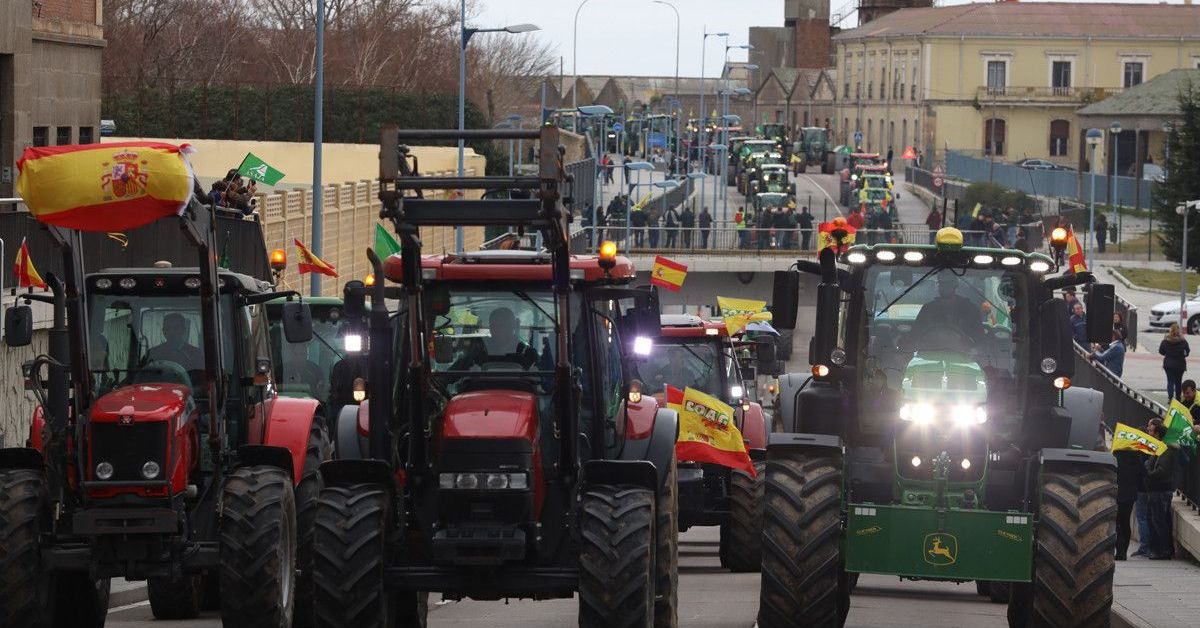
The trade agreement with Mercosur leads professionals in the field to resume protests. They will come out again to make themselves heard, at the national level, from January 26 to 30 to protest the cuts to the future Common Agricultural Policy (CAP) and the EU-Mercosur trade agreement.
This is a joint decision by the agricultural associations of the Agrarian Association of Young Farmers (Asaja), the Coordinator of Farmers and Ranchers Organizations (COAG) and the Union of Small Farmers and Ranchers (UPA).
These same protests will also move to the provincial level, with a date that has yet to be determined. Juan Luis Delgado, president of Asaja Salamanca, in conversations with this medium, confirms that the agreement with Mercosur “has not yet been signed”, it must be ratified by the commission in Uruguay, expressing that “this agreement has insufficient safeguard clauses. It is clear that we are not against trade agreements because we are a clearly exporting country, but we do disagree with the production conditions and that we compete under the same conditions with other countries at the same prices.”
The OPAS express a “resounding rejection” of Mercosur, stating that “it is time for the Spanish countryside to say that it does not agree with the measures that have prepared us for the future.” On the other hand, the organizations have valued the measures announced this past Wednesday with the President of the Government, Pedro Sánchez, to promote the generational change in the agricultural sector, welcoming the creation of a platform of agricultural land owned by the State, in which some 17,000 rural properties will be made available to young people. Although at the moment they are cautious, waiting to see what lands to offer.
Another of the measures announced was to allocate 10% of CAP resources to generational change in the agricultural sector. The UPA considers that it is a measure that goes in a “good direction”, since the EC left it at 6%, according to the Europa Press Agency.